Download

Netcode, rebuilt

When GameSpy closed in 2014, the originals' online play went with it. GOG and Steam brought it back through rooms hosted by players, where players report 150 to 300 ms on every server. Eternal starts over: dedicated servers, 64 players, a 60 Hz battle, and netcode written for real connections.

Players per battle
64Twice the 32 the GOG and Steam versions of the 2004 game allow.
Server simulation
60 HzEvery battle runs on a server at 60 ticks a second, and anyone can run a dedicated one.
Ping, Alabama to Atlanta
18 msMeasured. Players on GOG and Steam report 150 to 300 ms and more.
Upload per player
56 kbit/sMeasured with 64 players. Light enough for a weak uplink.

Online play, then and now

What the GOG and Steam versions of the originals give you online today, as their store pages, the press and their players document it, next to what Eternal does.

  1. 2004

    Online through GameSpy

    Both games' internet play ran on GameSpy's servers.

  2. 2014

    GameSpy shuts down

    Online play goes dark for both games.

  3. 2017

    Battlefront II returns, through GOG Galaxy

    Rooms are hosted on players' home connections. Players report failed joins and 150 to 300 ms on every server. [1] [2] [3]

  4. 2020

    Battlefront (2004) returns online

    Six years after GameSpy closed, a patch brings it back through Galaxy, for up to 32 players. [5] [6] [7]

  5. 2022

    Still over 200 ms

    A player reports nearly every server over 200 ms, with one or two people on it. [4]

  6. 2024

    The Classic Collection launches

    Three 64-player servers for nearly 10,000 players on launch night. Aspyr admits critical errors. [8] [9]

  7. 2026

    Battlefront Eternal

    Dedicated servers anyone can run, 64 players, 60 Hz, and a ping set by your distance to the server.

Ping you can expect

Eternal measured in our own tests. GOG and Steam as players report it on the forums, 2017 to 2022.

  • Battlefront Eternal, measured
  • GOG and Steam, as players report it
Table view
ConnectionPingBasis
Eternal: Alabama to Atlanta18 msMeasured, median of 12 sessions
Eternal: Frankfurt to Atlantaabout 100 msMeasured in the 64-client test
GOG and Steam, as players report it150 to 300+ msEvery server, 2017 to 2022
GOG and Steam versionsBattlefront Eternal
Players per battleUp to 32 (the 2004 game's store pages)Up to 64, with bots filling every empty slot
Who hosts the battlePlayers, often on home connections, found through GOG GalaxyA dedicated server in a datacenter, or the desktop app on your own PC
Ping players report150 to 300 ms and more, on every server (2017 to 2022)Your distance to the server: 18 ms from Alabama to Atlanta, about 100 ms from Frankfurt
JoiningFailed joins and overloaded matchmaking at the 2017 relaunchDirect connections, NAT punch-through, and a relay when nothing else gets through
Finding a gameGalaxy's room listA server browser with your measured ping, the map, the mode and who runs it

How a shot travels

Your PC never waits on the server to feel responsive, and the server never takes your PC's word for what happened.

  1. Your PC

    You press fire

    Your PC predicts it at once. Your soldier moves, aims and shoots without waiting for the server.

  2. Up

    Your inputs go up

    Thirty times a second, in packets small enough for a weak upload.

  3. Server

    The server decides

    It runs the battle at 60 Hz and judges each shot against where targets were on your screen.

  4. Down

    Snapshots come down

    Thirty times a second, with only what changed, nearest and most important first.

  5. Your PC

    Your screen catches up

    Other players move smoothly between snapshots, and small corrections to yours blend away instead of snapping.

What's in it

Every piece is new, from the handshake to the last pixel of a remote player's movement.

  • Written for this game

    A new multiplayer engine with its own encrypted UDP transport, BFE-UDP/1.

  • Server-authoritative

    The server runs every battle at 60 Hz and decides every hit, capture and kill. Clients send inputs, not results.

  • Client prediction

    Your soldier, droidekas, vehicles and starfighters respond at once. Your PC replays what the server hasn't confirmed yet, then blends small corrections away.

  • Lag compensation

    Shots are judged against where targets were on your screen, never further back than your own connection justifies, and never more than 0.6 s.

  • Delta snapshots

    Only what changed since the last snapshot you confirmed, nearest and most important first, within a budget for each player.

  • Holds up under packet loss

    A lost snapshot is never resent or waited on. With 5% loss in testing, snapshots still arrived at the link's own latency.

  • Encrypted and authenticated

    X25519 key exchange, AES-256-GCM, and Ed25519 identities on both ends. Forged, tampered or replayed packets are dropped.

  • Route racing

    A join starts from six ports at once, then times sixteen and moves to the fastest route through your ISP: 6 ms quicker on average in testing.

  • Roaming

    Switch from Wi-Fi to LTE and the session follows you in one round trip, without rejoining.

  • Direct

    Direct connections where possible, NAT hole punching through the master server, and a relay when nothing else gets through. IPv4 and IPv6.

  • A network thread on the server

    Packets never wait on the game. In testing, round trips fell by 1.15 ms and the worst state delay by about 30%.

  • One netcode everywhere

    Instant Action runs as a local server on the same netcode as online play, so both behave the same.

  • Fair limits

    Input floods are dropped, never kicked. One network holds eight sessions by default, and servers can apply a signed ban list.

  • Version check

    Client and server compare versions as they connect. An outdated client is told to update instead of falling out of sync.

Next

  • Tested on real-world networks. Play tests behind carrier-grade NAT and over cellular connections.

Later

  • Relays over TCP. For networks that block UDP.
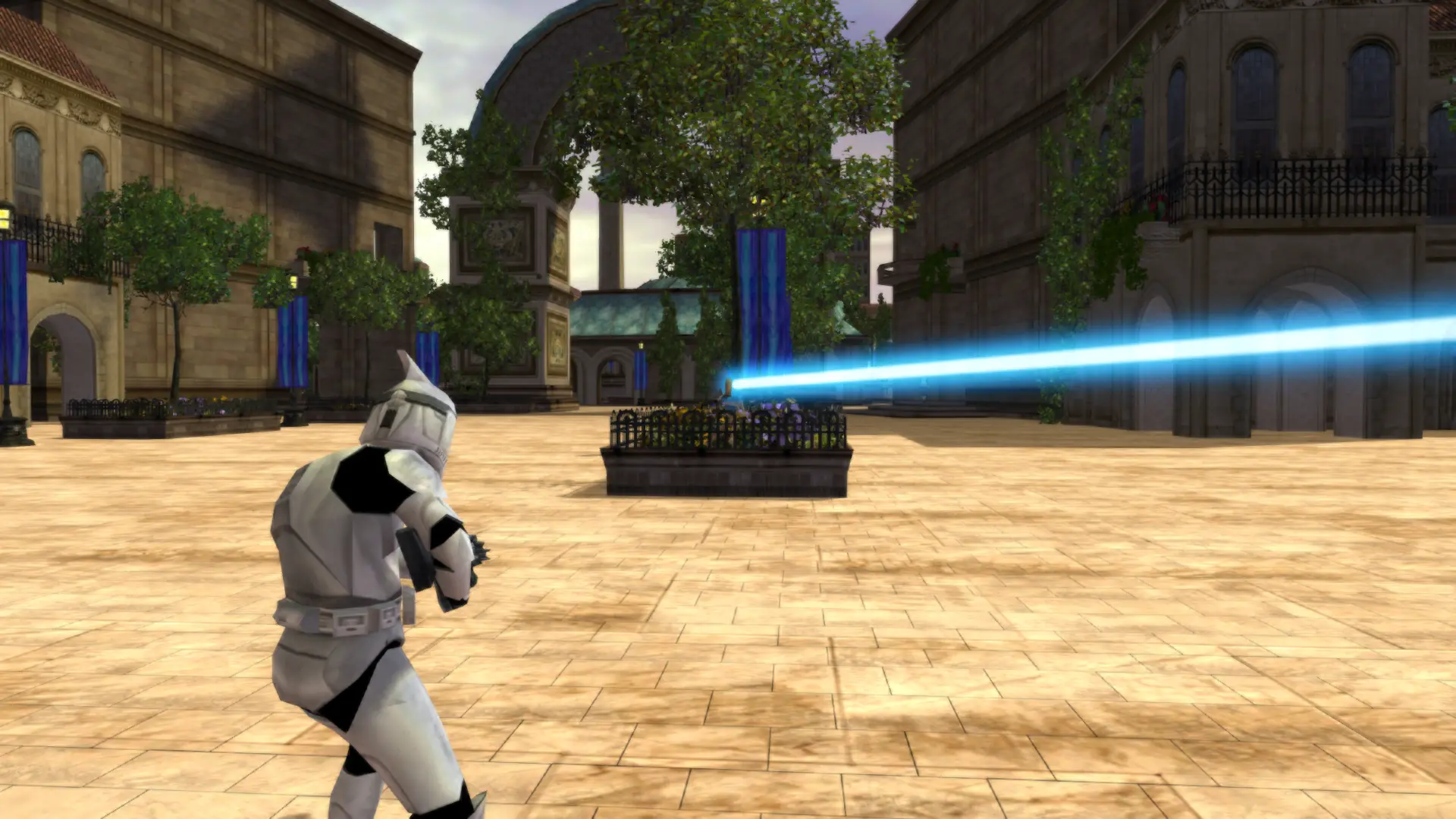
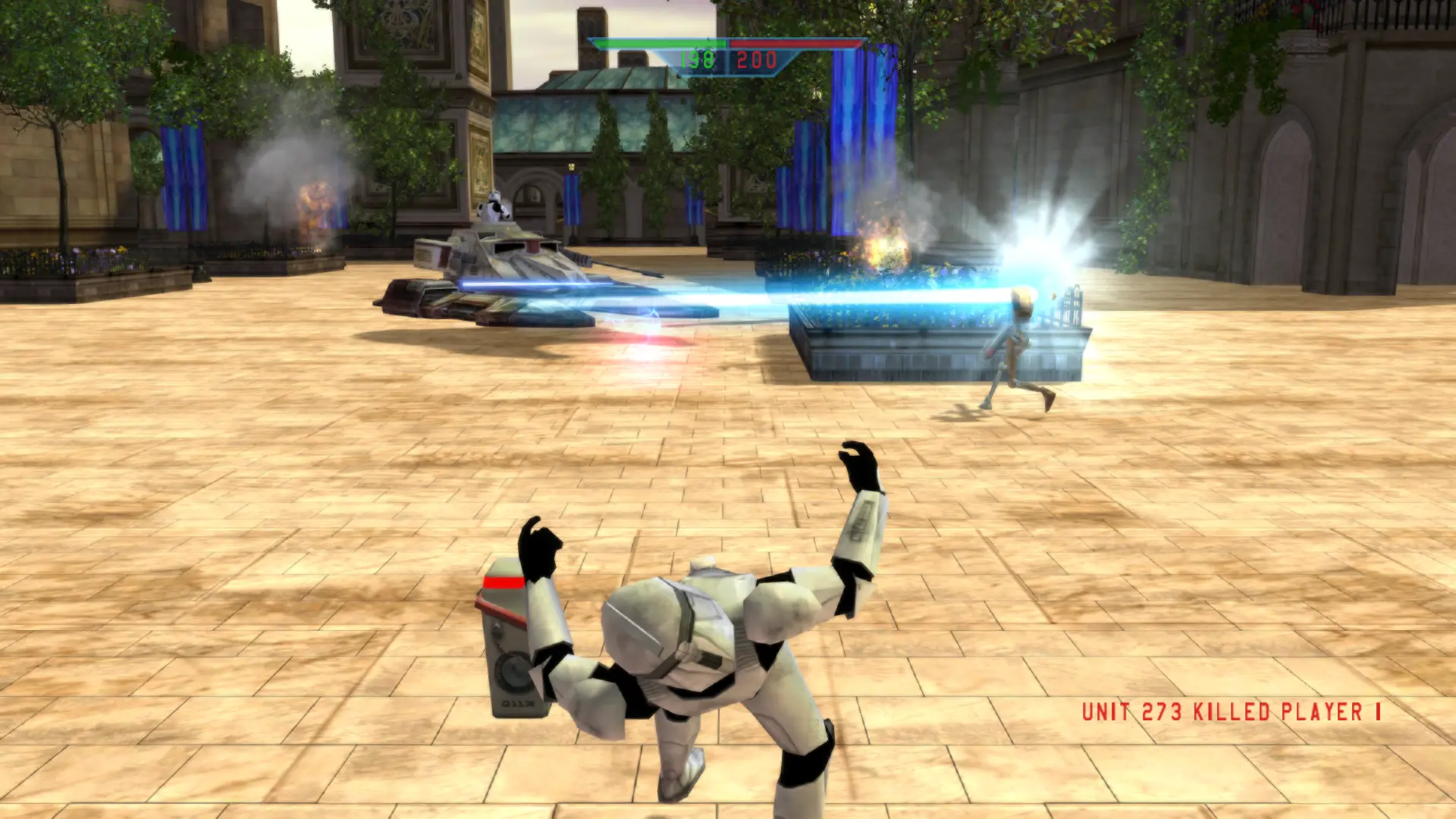
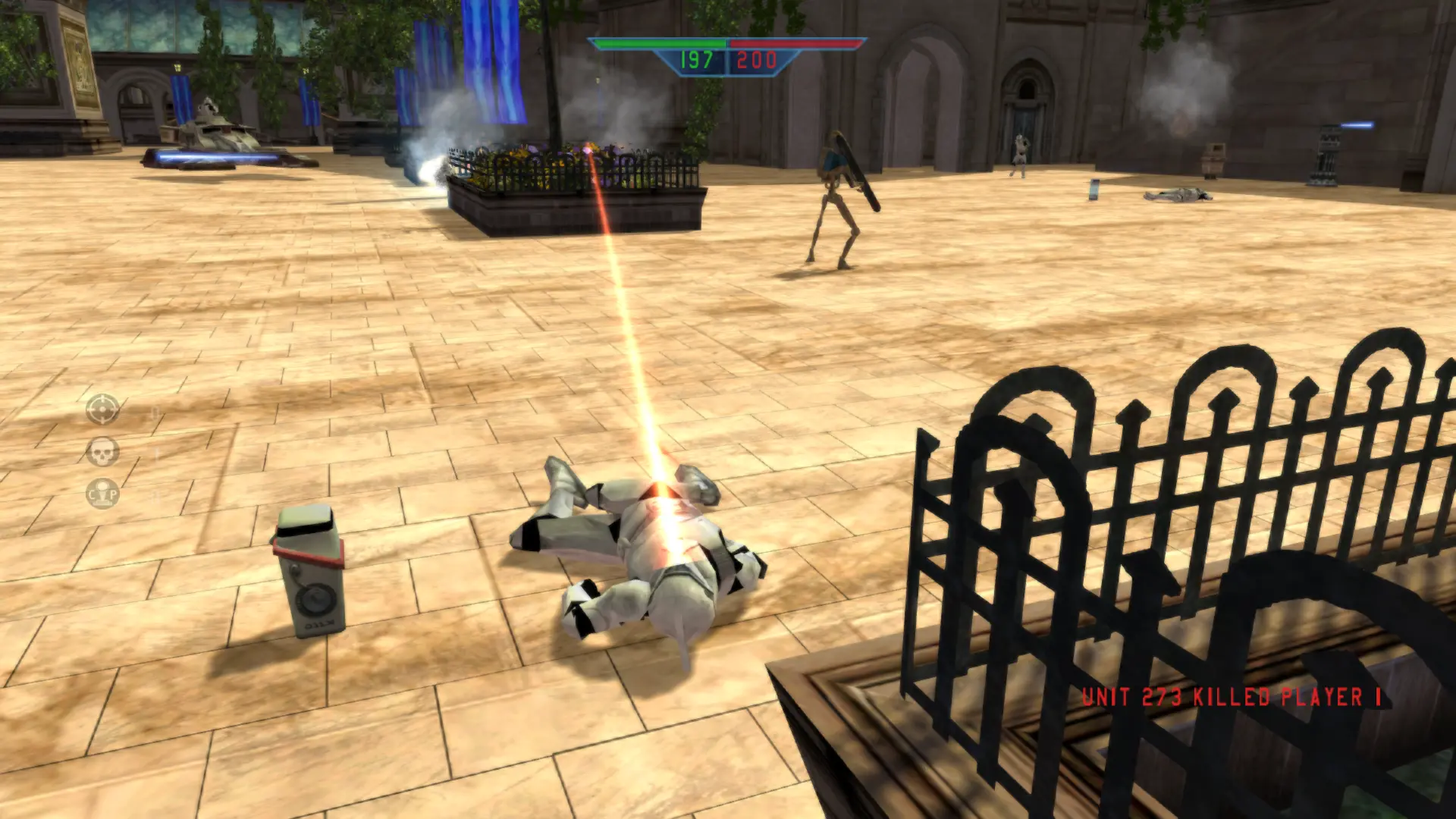
A clone trooper thrown back by a blaster hit on Theed's plaza, bolts flying past a tank.
Your shots fire on your screen at once. The server decides what they hit.
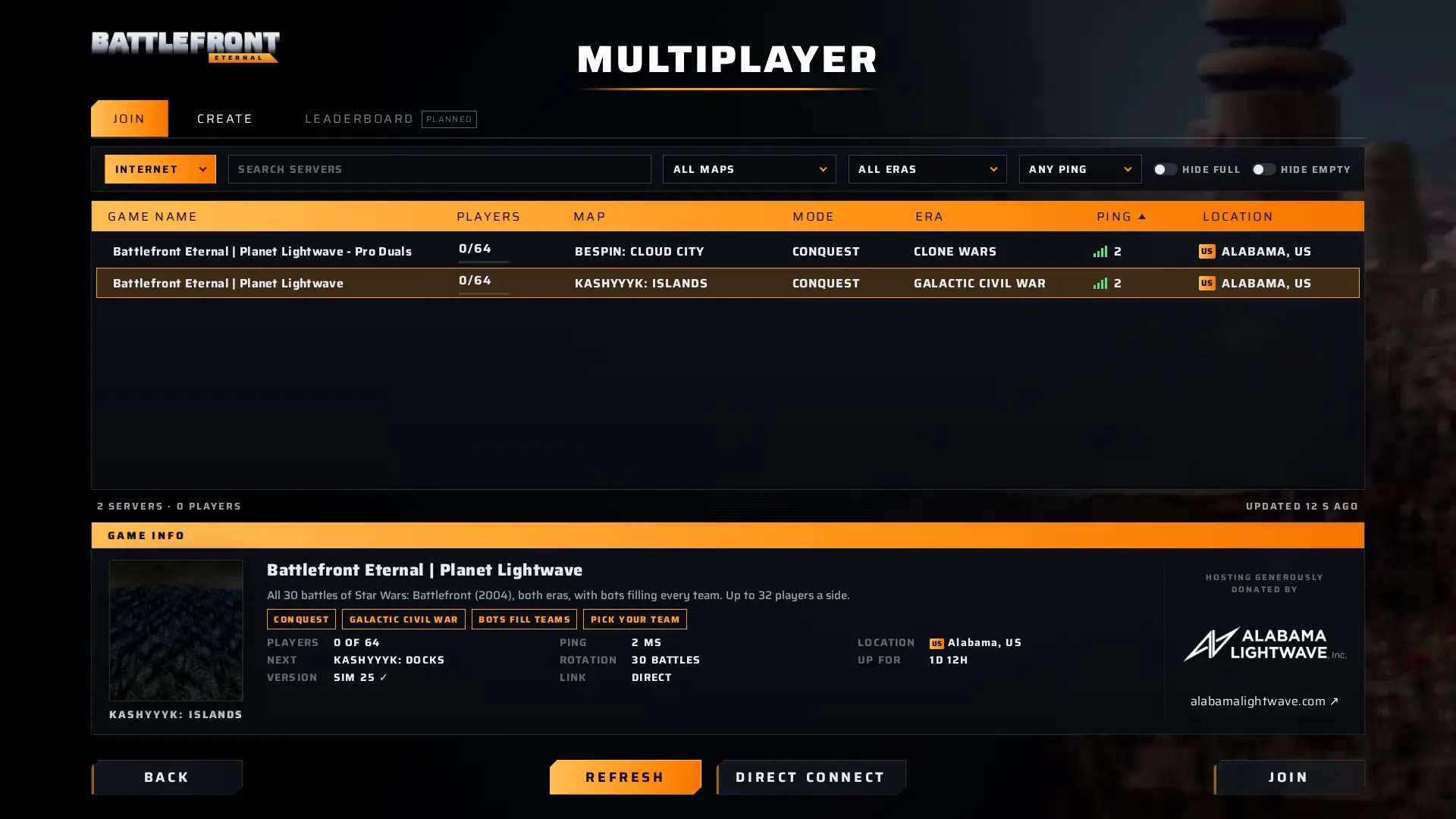
The server browser listing the Planet Lightwave servers with their ping.
Ping in the server browser is measured from your own PC.

Tested on real machines

Load tests run real clients over the internet against real servers, with the same code players run.

October 16, 2026

64 clients, real machines

One Linode server in Atlanta and 64 clients in Atlanta, Newark, Washington, Chicago, Dallas, Fremont and Frankfurt, 32 against 32 on Naboo: Theed. The server held 60 ticks a second with no dropped ticks and no client errors.
October 16, 2026

Bad networks, on purpose

Shaped links with 200 kbit/s upload, 60 ms delay each way and 5% packet loss. Snapshots still arrived in a median 63 ms, the link's own latency.

October 17, 2026

63 players on the public server

A full load test on Planet Lightwave from Linode, half over IPv4 and half over IPv6. The fixes it called for shipped the same day, and the rerun held 60 ticks a second with no packets dropped.

Questions, answered

Is it peer-to-peer?

No. Every battle runs on a server: a dedicated server, or the one the desktop app hosts. Players connect to it, never to each other.

Why was the original laggy online?

Since GameSpy closed in 2014, the GOG and Steam versions have found games through GOG Galaxy, and battles are hosted by players, often on home connections. Everyone's ping depends on that host, and players report 150 to 300 ms and more. Eternal is built around dedicated servers in datacenters, so your ping is your distance to the server.

Do I need to open ports to play?

No. Players connect out. Only a server's host opens UDP and TCP 18451, or 18461 when hosting from the app, or lets a relay carry the traffic.

What happens on a bad connection?

A lost snapshot isn't resent, on purpose: a newer one is already on the way. Your PC keeps drawing other players smoothly between the snapshots it gets, and your own soldier keeps responding at once.

Can a modified game cheat?

A client sends only its inputs. The server simulates the movement and rules on every hit, so a modified game can't declare its own kills or move itself across the map.

Sources

On the original games online, checked October 22, 2026. Player reports are quoted from public forum threads and describe those players' experience at the time.

  1. GOG are responsible for Battlefront II classic's new multiplayer patches. PCGamesN, October 2, 2017, updated January 5, 2018.
  2. Lag and Ping problems (Battlefront II, Classic, 2005). Steam Community, October 12, 2017.
  3. Multiplayer issues (Battlefront II, Classic, 2005). Steam Community, October 13, 2017.
  4. Play some multiplayer, huh? (Battlefront II, Classic, 2005). Steam Community, March 2022.
  5. Star Wars: Battlefront Classic: Mehrspieler-Funktionen werden wiederbelebt. ComputerBase, May 2, 2020.
  6. STAR WARS Battlefront (Classic, 2004). Steam store page, "Fight up to 32 players".
  7. STAR WARS Battlefront (Classic, 2004). GOG store page, "Fight up to 32 players".
  8. Players tear into Aspyr for bugs, crashes, and 3 64-player launch servers for nearly 10,000 users. PC Gamer, March 2024.
  9. Classic Collection devs admit "critical errors" were made. GamesRadar+, March 2024.

Join the fight

Find a server in the in-game browser, or run your own.